5 Ways to Protect Your Writing in the Age of AI!
January 22, 2026
@2026 The Author’s Writer
Have you ever driven on a roundabout? One near my home has a 100-year-old oak tree in the center. Though the roundabout is beautifully landscaped, most people don’t know how to navigate the lanes. They exit into the wrong lane, make quick lane changes, cut other vehicles off, and drive too fast. The same can be said about the writing process. Not everyone who enters the roundabout will produce a first draft. There are going to be stops and starts. There will be accidents. Rules will be broken, some with good consequences, others with false narratives.
The metaphor of the roundabout reveals the true nature the writing process. It is concentric, circular, and elliptical. A lot of people who sit down to write naturally believe that writing a book is a tidy process (i.e. idea, outline, draft, revision, edit, proofread) because that’s how they were taught in school. Yet writing is never as easy as moving forward in a straight line from one point to another.
I was once told by an artist friend that the circle is the perfect shape. With a circle there is no distinct beginning nor end, only a curved line that connects infinitely. The writing process is similar, though there will be a time when we need to stop writing. Maybe. Never. Always. Will we ever really stop? Will our stories ever end? What about our love of our characters?
We all have ideas of what we would like to write before we write. However, we always surprise ourselves when we put pen to paper. We go back and forth and round and round in directions never imagined. But, if we’re dead set on proceeding in a step-by-step fashion, we are going to skip the concentric process. That’s why a lot of books don’t get finished.
As I said earlier, I do not blame anyone for believing that the writing process is linear. Most of us were taught to write as such in school. We were taught to create a stringent outline and to write in an orderly succession of steps. We were taught that structure is more important than content. The problem with the linear method is that it doesn’t invite exploration, trial and error, and discovery. Writers do not always know what they are going to write before they write. They have ideas in their head, yes, but most find out that they don’t have all of the answers. When new ideas emerge and don’t fit into the predestined structure, they may stop or get writer’s block.
When I started teaching, one of the first things I taught was to dispel with outlines. Why? Because writing to an outline forces writing where it may not want to go. Some people like to be in control and insist upon creating an outline. If that’s you, then go for it. Just make sure that your outline is flexible enough for you to wander outside of its confines. If you have a last-minute thought or new idea, be open to adjusting your outline. I like to consider structure to be more like a flexible scaffold that can be taken down and moved around when inspiration strikes.
Many of us find it difficult to do away with the rules we learned in school. That is why writers should try to “de-school” themselves. To do so, you must rely upon your instincts. This may feel uncomfortable because you are entering unknown territory. When there are no rules or boundaries, what are you going to write about? The answer is you are going to put pen to paper and see where your writing leads you. Don’t try to lead it.
Get it into your core that it’s okay if your thoughts are discombobulated. It’s okay if you write in stream of consciousness. It’s okay if you don’t know what you’re going to write. It’s okay if you don’t feel like writing. It’s okay if you don’t like what you write. Just write. Don’t think. Don’t judge. Just write. And don’t edit when you write. Don’t worry about punctuation, word choice, spelling, capitalization, or grammar, or even about sentences. Those are editing rules and have nothing to do with creating or even writing. This is a difficult concept for some of us to fathom because these rules have been ingrained in us.
We’re used to getting grades. We’re used to getting feedback. Yet writing without judgement is so much more fun than waiting for someone to criticize our work. But we can also act as our own judges when we are too hard on ourselves. It is very difficult to write when we are being continually judged. When we were small children, we scribbled with crayons on paper and were praised for it. Somewhere along the way, we were taught to color within the lines. We simply agreed to make our teachers happy, so, in return, we got five stars on our paper. But, what about us? Were we happy? What if we wanted to color outside of the lines?
Writing is all about coloring outside of the lines. It’s about authenticity and being true to yourself. Once we eliminate rules and judgement, writing may become messy, but it will also be fun. For those of us who like being in constant control, however, getting messy may be out of our comfort zone.
When we let go of rules and judgement, we begin to discover. We begin to learn about the stories that dwell within us. When we write uninhibited, we learn how to ask questions and where to look for answers. We may find that we don’t know as much about our subject as we thought and that our ideas merely scratch the surface. But oftentimes, those answers lie within us just waiting to be discovered. So, we start with an idea. We begin writing. We hit a dead end. We start asking questions. We dig deeper. We may hop down a rabbit trail or two. Maybe it’s productive. Maybe not. But our journey is all the better for it because we do not think we have all the answers. We are willing to explore. And, in doing so, our thinking matures. We become changed when we don’t run away but try to work things out.
So, we start with an idea, but we may not stick with the idea. We may no longer think our idea is viable and need to extend it or sharpen it. We won’t know this until we begin to write about it. We compose drafts, which do not yet have a beginning, middle, or end, or maybe they do. After writing a draft or two, we set it down for a short period of time then re-read it with a fresh set of eyes. And so begins the revision process—or re-seeing of the draft—which may send us back to our original idea again. Is our subject worth writing about? We may decide to do more revisions. We may start over. We may continue. It just depends.
Once we feel firm about what we have written, we begin to think about our readers. Will our ideas make sense to them? What universal themes do we write about that resonate with others? What will keep them reading?
That’s where editing comes in. We read our work aloud, hearing those awkward sentences or less than desirable word choices. We may rearrange the chapters, we may eliminate the fluff, so our best ideas stand out. We may go round and round until we feel we got things right. And even then, we may get a new idea or feel inspired and round and round we go again. Will it ever stop? Maybe not. At least not until we understand our true message.
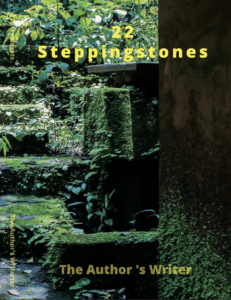
Hi. I’m Wendy, The Author’s Writer. You’ve just read the first part of my latest book entitled,
22 Steppingstones: A Trusty Guide to Take with You on Your Writing Journey.
Are you writing a book? I’d like to help. I offer consulting/coaching sessions, writing programs, book doctoring, and ghostwriting. Contact me at authorswriter@yahoo.com.